See, this is a common misconception, here's a copy and paste, so ignore SOME details:
"...Okay, for all the people saying that the Spinosaurus is outdated, you're right, but for the people saying it was 4 legged, that's debatable, see, here's a blog post by a paleontologist: http://www.skeletaldrawing.com/home/theres-something-fishy-about-spinosaurus9112014
However, its worth noting that the authors did make a rebuttal to this: http://www.skeletaldrawing.com/home/aquatic-spinosaurus-the-authors-responsd9182014
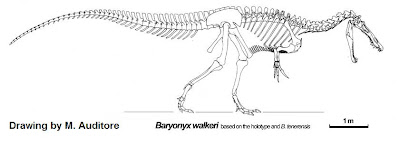
Now there isn't a war going on, and the authors do believe that they're right, and they aren't just people trying to "downgrade" Spinosaurus. Either way, the new discovery has shed some light on Spinosaurus as a whole, not just the legs. Firstly, its length was reduced, Spinosaurus had a much larger head proportionally than what was previously believed, that's where the 15.6 metre and 16 - 18 metre estimates came from (for MSNM V4047, the largest specimen, which was just a mandible). And, by extension, its mass. Which, when talking about animals, is used as a measurement of size, instead of length, height or width. As an Elephant is clearly larger than a Giraffe or a Reticulated Python, despite the latter two being taller and longer respectively, as mass is easier to measure than volume, and 99% of the time is indicative of volume.
In the 2014 paper, MSNM V4047 was estimated at ~15.2 metres, and 6 - 7 tonnes in weight. However, some other people have made extensive estimates and measurements, and ended up with different results: Either way, Spinosaurus is no longer the undisputed largest theropods, at 6 - 7.6 tonnes in weight. As Giganotosaurus carolinii was 12.4 - 13.2 metres in length, and 6.8 - 8.2 tonnes in weight. Carcharodontosaurus was 12.2 - 13.2 metres and 6.3 - ~8 tonnes in weight, T. rex was a 11.3 - 12.3 metres in length and 6.4 - 8.4 tonnes in weight. And Mapusaurus was 10.3 - 12.4 metres, and ~4 - ~7 tonnes in weight.
The similar weights at different lengths are due to their builds, the large Tyrannosaurines were really robust, solidly built and had almost comically wide abdomens. Spinosaurus was by far the longest theropod, but, by comparison was quite skinny and more streamlined, likely for aquatic life, and had a shallow torso for its length. While the Carcharodontosaurids were somewhere in the middle. Now keep in mind, since most of these theropods have very little, and some fragmentary remains, we cannot reliably estimate the actual mass of their populations. Even T. rex, with the most specimens, we cannot assume, we can, at best, use their average individuals, or the mean between their individuals (e.g. if 95% of specimens were 6 tonnes, and there were 5% that were 10 tonnes, use the 6 tonnes as the average.
But if we have very few specimens, either use the likely adult, as with Spinosaurus, or use the mean. The best I can do is compare individuals, so, since we cannot compare the averages of the species, I can use the average of the individuals, and the average estimates of said individuals. So:
Mapusaurus roseae - 11.4 metres, 5.3 tonnes
Spinosaurus aegyptiacus - 14.8 metres, 6.9 tonnes
Carcharodontosaurus saharicus - 12.7 metres, 7.2 tonnes
T. rex - 11.9 metres - 7.2 tonnes
Giganotosaurus carolinii - 12.8 metres, 7.3 tonnes
Again, the few specimens of most of these theropods make it nigh-impossible to accurately determine the average of the species. So for all we know, Mapusaurus' "maximum" could be its average, and Giganotosaurus' "minimum", could be its average.
Now, for the largest, I will use the highest estimates that are actually plausible, and aren't outdated:
Mapusaurus roseae - 12.4 metres, ~7 tonnes
Spinosaurus aegyptiacus (MSNM V4047) - 14.8 metres, 7.6 tonnes
Carcharodontosaurus saharicus (SGM DIN 1) - 13 metres, ~8 tonnes
Giganotosaurus carolinii (MUCPv-95) - 13.2 metres, 8.2 tonnes
Tyrannosaurus rex (FMNH PR 2081) - 12.3 metres, 8.83 tonnes
DO NOT, use these sizes as the averages of the species, but feel free to debate on the individuals. Also, this is really getting on my nerves...
BITE FORCE IS NOT EVERYTHING. A slashing, cutting bite can be just as deadly as a crushing one. Just in different ways, and in some cases, one will be highly effective against one creature and less useful against another, while the other will be the opposite way around. For example, a crushing bite will be more useful against an Ankylosaurus (which, is also overrated, the largest specimen was 5 tonnes), but not as useful against a large Sauropod, just for the latter's sheer size. While a slashing bite will be less effective against an Ankylosaurus, but more useful against a large sauropod, as they can let it bleed out, and use hit and run tactics more effectively.
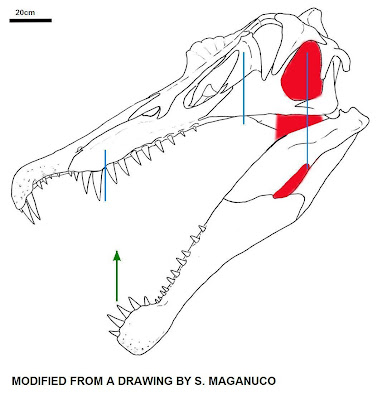
Carnivores with a slashing bite also tend to have a larger gape than ones with a crushing bite, but there are exceptions, such as Crocodiles. Now Spinosaurus' bite is obviously a gripping one, it likely had a higher bite force than a Carcharodontosaurids. Due to the nature of the teeth, and the robustness of the skull from a top view. Similarly to how Crocodiles have powerful bites despite their elongated skulls, though to a lesser extent. It wasn't as slim as a Gharial's, nor as robust as a true Crocodiles. Somewhere in the middle, so its not going to have a 10 tonne bite force. Obviously specialized for fish. Though, against these theropods, its going to just be a weaker version of T. rex's bite, though still deadly, it would only have a fraction of T. rex's 6 tonne bite force. And admittedly would be the least effective, though, it could potentially use its bite to keep a hold on and possibly use its arms, though they are often exaggerated in efficiency. They are also obviously not adapted to slashing at a similarly sized opponent, against said opponent(s), they would probably have to use a grip and tear strategy. However, obviously, in deep(ish) water, they're all fodder to Spinosaurus. I also feel a need to post the 8.4 tonne estimate for T. rex, as it seems to be the most rejected estimate of all of these...for whatever reason some people still cling on to the 5 - 6 tonne T. rex of old... Anyway, here it is!
http://www.skeletaldrawing.com/home/mass-estimates-north-vs-south-redux772013
It also has the mass estimation for Giganotosaurus too, so there's that."
Edit: Lengths are measured along the centra, not over the curves of the spine, even though the latter is the "correct" way to measure their lengths, it avoids confusion, as 12.3 metres for Sue is pretty much universally accepted (except for people living in the past). Here's an example of Sue measured in a straight line, along the centra and over the curves of the spine: https://drive.google.com/file/d/0B-K0fMJPZ1apNHFldE81eWplNVk/view
Edit II: Not sure if "largest land based carnivore" is really doing it justice, as its a semi-aquatic creature.
Oh, and here's a more accurate size chart - https://franoys.deviantart.com/art/Giant-predatory-dinosaurs-comparison-616409616
And I know DeviantArt is (usually) a bad source, but there are some actual people on there that know what they're doing (e.g. Scott Hartman).




Log in to comment